Vol. 12 · No. 4 · Autumn 2026SubscribeSubmit a manuscriptSearch
JIFinJournal of International Finance
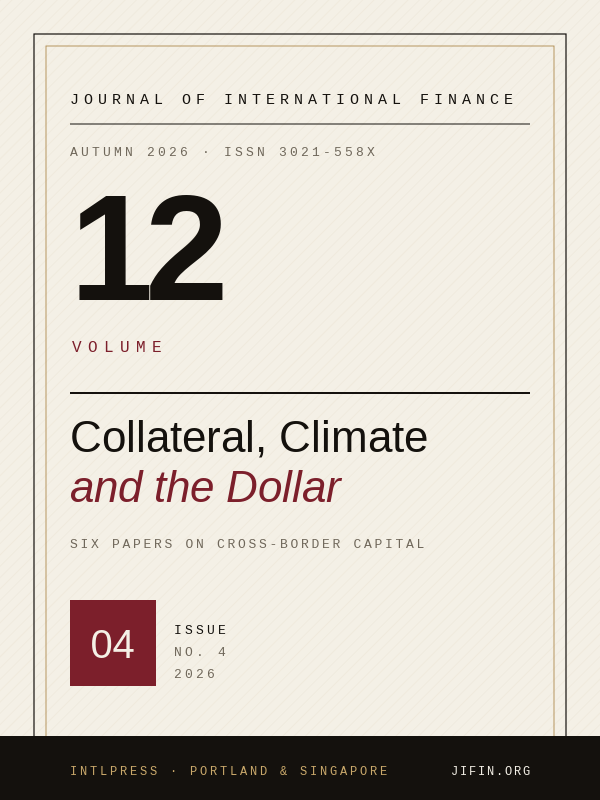
Cover of Autumn 2026
Volume 12 · Issue 4

Autumn 2026

September 18, 2026

Six papers on collateral, climate risk and the political economy of cross-border finance, with three video briefs from the authors.

Articles5
Pages393
01
collateralSep 18, 2026doi:10.62317/jifin.2026.12401

Collateral Chains and the Geography of Dollar Credit

We assemble a novel panel of 41 jurisdictions to trace how collateral reuse reshapes the geography of dollar-denominated credit. Rehypothecation intensity predicts a 14 percent compression in cross-border…

Elena Vartanian, Marcus Oyelaran, Priya Raghunathan4–31
02
climate financeSep 18, 2026doi:10.62317/jifin.2026.12402

Climate Transition Risk in Sovereign Debt Markets

Sovereign spreads embed transition risk only after disclosure becomes mandatory. Using a synthetic cohort of 28 issuers, we estimate a 37 basis point premium for undisclosed carbon intensity, concentrated in…

Priya Raghunathan, Tomás Ibarra32–58
03
monetary policySep 18, 2026doi:10.62317/jifin.2026.12403

Monetary Transmission in Small Open Economies

Pass-through from policy rates to bank lending rates is slower and smaller in small open economies, but only where foreign-currency deposits exceed twenty percent of household balances.

Marcus Oyelaran, Hannah Lindqvist59–82
04
payment systemsSep 18, 2026doi:10.62317/jifin.2026.12404

Payment Systems and the Corporate Hedge

Firms that settle through real-time payment rails hedge a larger share of their payables, because settlement finality reduces the cost of holding precautionary liquidity.

Mei-Ling Chen, Hannah Lindqvist83–101
05
capital controlsSep 18, 2026doi:10.62317/jifin.2026.12405

The Political Economy of Capital Controls

Capital-account restrictions are more likely to be retained where the banking sector is concentrated and where fiscal revenue depends on financial-activity taxes.

Adaora Okonkwo102–121